
How to Hold a Precise Board-to-Board Gap with Sn10Pb90 Solder Spheres
Posted by EasySpheres on 12th Oct 2026
Engineers stacking two circuit boards, or mounting a module onto a board, often need a guaranteed gap between them. A standard solder ball melts and collapses, so the gap is hard to control. High-lead Sn10Pb90 solder spheres solve this by staying solid during assembly and acting as a precision spacer.
Looking for Copper Core Spheres? Consider Sn10Pb90
We receive many requests for copper core solder balls, which are chosen mainly because they do not collapse and so hold a fixed stand-off. EasySpheres does not currently offer copper core spheres. For many board-to-board and module-attach applications, Sn10Pb90 delivers the same non-collapsing behavior in a solid solder sphere, and it is a core, readily available EasySpheres alloy.
| Consideration | Sn10Pb90 solder sphere | Copper core sphere |
|---|---|---|
| Holds stand-off in reflow | Yes, when the peak stays below 268 °C | Yes, at any normal reflow temperature |
| Attach method | Solder paste on both pads | Solder paste on both pads |
| Construction | Homogeneous alloy, Sn10 / Pb90 | Copper core with plated layers |
| Compliance | Leaded; RoHS exemption required | Depends on plating and solder used |
| Best fit | Fixed gaps where the process stays below 268 °C | Applications that must survive later high-temperature steps |
How the Non-Collapsing Sphere Method Works
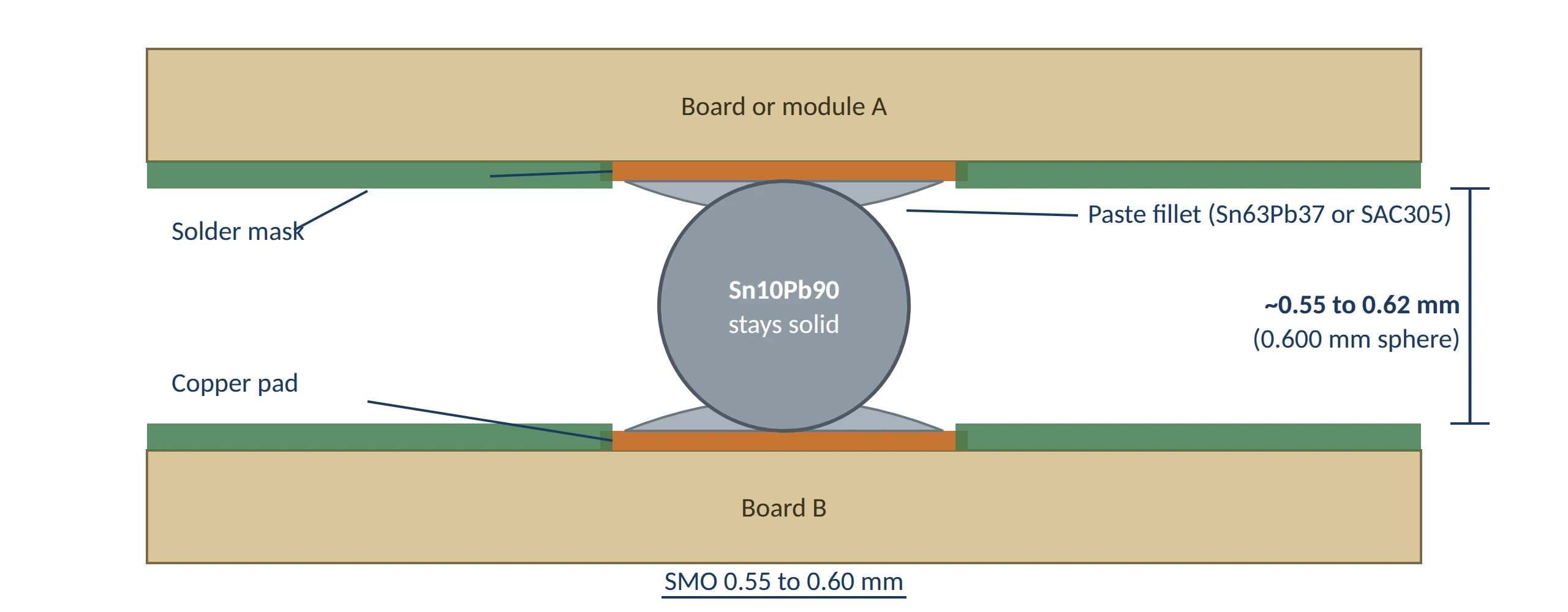
Sn10Pb90 has a solidus of 268 °C and a liquidus of 302 °C. Standard Sn63Pb37 paste melts at 183 °C, and SAC305 paste at about 217 to 220 °C. During reflow the paste melts and wets both the pad and the sphere, while the sphere itself stays solid. This is the same principle long used for high-lead spheres on ceramic BGA packages.
Land Geometry: Different from SAC Spheres
For SAC alloys that melt and collapse, the solder mask opening is often reduced to roughly 75 to 83% of the ball diameter to control the joint shape. With a non-collapsing Sn10Pb90 sphere, a larger opening is usually better because it holds more paste and forms a larger, more fatigue-resistant fillet. Typical starting points for a 0.600 mm sphere at 1.20 mm pitch:
- Solder mask opening of about 0.55 to 0.60 mm, used on both boards so the joint is symmetric.
- For solder-mask-defined pads, at least 0.05 mm of mask overlap per side after registration tolerance, with mask-to-copper registration of ±0.05 mm or better.
- ENIG (thin gold) or OSP surface finish.
Paste, Stencil, and Reflow
Use solder paste, not flux only. Flux cannot form a joint when the sphere does not melt. A typical process prints paste on the first board, places the spheres, and reflows. Paste is then printed on the second board, the first board is aligned on top with a fixture, and the stack is reflowed again.
| Starting point | Sn63Pb37 paste | SAC305 paste |
|---|---|---|
| Time above liquidus | 45 to 90 s above 183 °C | 45 to 75 s above 217 °C |
| Peak at joint | 210 to 225 °C | 235 to 245 °C |
| Margin below 268 °C solidus | Large | Smaller; tighter control needed |
| Stencil | 0.125 to 0.150 mm thick, round apertures about equal to the mask opening | |
The paste manufacturer's data sheet governs the profile. Thick or stacked boards have high thermal mass, so profile the real assembly with thermocouples at the center and corner of the array.
Stand-off You Can Count On
Because the sphere does not collapse, the gap is close to the sphere diameter. EasySpheres Sn10Pb90 spheres are held to a maximum dimensional tolerance of ±4%, with typical measured tolerance of ±0.83% in the 0.600 to 0.889 mm range and sphericity deviation under 1.5%. Even at the worst-case lower limit, a 0.600 mm sphere is still 0.576 mm, which leaves generous margin for most stand-off requirements. Board flatness and consistent paste volume are the main variables to control.
RoHS and Compliance
Sn10Pb90 contains lead above the RoHS limit and is not RoHS compliant as supplied. RoHS Annex III Exemption 7(a), for high-melting-temperature solders containing 85% or more lead by weight, may apply to the sphere. A Sn63Pb37 paste fillet does not meet that threshold and is not covered by Exemption 7(a). Users are responsible for confirming that a valid exemption covers the complete joint and the end product.
Frequently Asked Questions
Can Sn10Pb90 solder spheres be used instead of copper core spheres?
In many board-to-board and module applications, yes. Sn10Pb90 has a solidus of 268 °C, so it stays solid when attached with Sn63Pb37 or SAC305 solder paste and acts as a precision spacer. Unlike a copper core sphere, it will melt if the assembly is heated above 268 °C, so the reflow peak must stay safely below that point.
Can I attach Sn10Pb90 spheres with flux only?
Not in a non-collapsing process. If the sphere does not melt, flux alone cannot form a joint. Solder paste printed on the pads provides the solder that joins the sphere to each board.
What stand-off can I expect from a 0.600 mm Sn10Pb90 sphere?
Because the sphere does not collapse, stand-off is close to the sphere diameter. A 0.600 mm sphere typically gives a board-to-board gap of roughly 0.55 to 0.62 mm, depending on mask thickness and paste volume. Measure it during qualification.
What reflow temperature should I use with Sn10Pb90 spheres?
Use the profile for the paste, not the sphere. With Sn63Pb37 paste, a joint peak of about 210 to 225 °C is a typical starting point; with SAC305 paste, about 235 to 245 °C. Keep the peak well below the 268 °C solidus of Sn10Pb90 and follow the paste manufacturer's data sheet.
Is Sn10Pb90 RoHS compliant?
No. Sn10Pb90 contains lead above the RoHS limit. RoHS Annex III Exemption 7(a), for high-melting-temperature solders containing 85% or more lead, may apply to the sphere, but a Sn63Pb37 paste fillet is not covered by that exemption. The user is responsible for confirming that a valid exemption covers the complete joint and end product.
The values in this article are engineering starting points, not a released specification. Validate land geometry and process with cross-sections, X-ray, and stand-off measurement, and refer to IPC-7095, IPC-7351, J-STD-001, and IPC-A-610.